The Cisco Catalyst 9200 and Catalyst 9300 are both stackable access switches running Cisco IOS XE. The 9300 is the bigger platform, with faster stacking, more memory, StackPower, and UPOE, UPOE+ and SFP fiber ports that the 9200 and 9200L don’t offer. The short version: a 9200L or 9200 covers most closets of PoE+ phones […]
Author Archives: Brian Shevack
Meraki cloud management means every Meraki device is configured, monitored and updated from one web dashboard instead of on the device itself. Only management lives in the cloud. User traffic never passes through Meraki’s servers: the firewall, switches and access points forward it locally, like any other network. The short version: Meraki’s cloud model pays […]
The Cisco Meraki MX is Meraki’s firewall: one box at each site that handles routing, firewall rules, site-to-site VPN and SD-WAN, managed from the Meraki dashboard. Content filtering, intrusion prevention and malware protection come with the Advanced Security license tier. If you’re buying: the MX67 and MX68 cover small branches, the MX75 and MX85 busier […]
Yes, for a small business. HPE Networking Instant On switches (sold as Aruba Instant On until the rename) give you VLANs, PoE, QoS and a phone app to run them, with no license fee and HPE’s limited lifetime warranty. They sit between plug-and-play unmanaged switches and enterprise lines like Cisco Catalyst and HPE Aruba Networking […]
The best Cisco access point depends on two things: how many devices it has to serve, and how you want to manage it. Cisco’s lineup spans three generations: Catalyst 9100 (Wi-Fi 6), Catalyst 9160 (Wi-Fi 6E) and Cisco Wireless 9170 (Wi-Fi 7). Many networks still run the Aironet 1800, 2800 and 3800 (Wi-Fi 5). The […]
A hub repeats everything it receives out of every other port. A switch learns which device is on which port and sends traffic only where it’s addressed. That one difference is why hubs are slow and noisy, and why every wired business network today is built on switches. If you’re buying: buy a switch. You […]
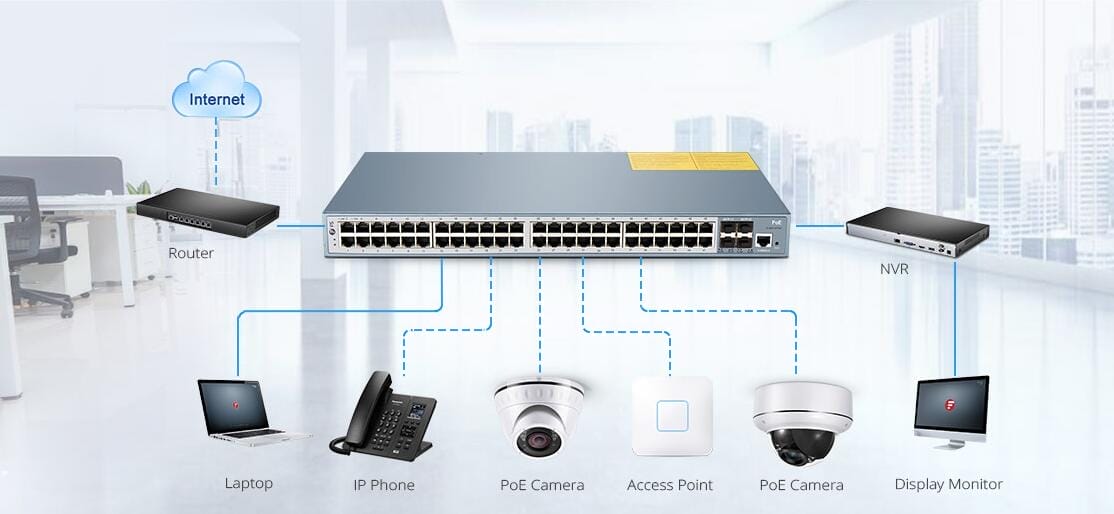
A PoE switch sends power and data down the same Ethernet cable, so a phone, camera or access point needs no power outlet. Before it powers a port, the switch checks that a PoE device is actually connected and asks how much power it needs. Plug in a laptop and the port stays plain Ethernet. […]
Cisco’s business switches come in two families. Catalyst switches run offices, campuses, schools and warehouses. Nexus switches run data centers. For almost every business buyer the answer is a Catalyst, and the real question is which series and which part number. The short version: Catalyst 1000 or 1200 for small offices, Catalyst 9200 for most […]
Every business network is built from the same few pieces of hardware: something that brings the internet in, a router or firewall that protects and directs traffic, switches that connect wired devices, access points for Wi-Fi, and the cabling, racks and power that hold it together. Size and brand change from site to site; the […]
An enterprise router connects your sites to the internet, to each other and to your data center. Compared with a small-office router it handles far more traffic, several internet links at once, VPNs to many sites, routing protocols like BGP, and redundant power, and it’s built to run for years without a reboot. The best […]
To remove a Meraki device from a network, open the network’s device list, tick the device and click Remove. That takes it out of the network but leaves it in your organization. To release it completely, so someone else can claim it, you also have to unclaim it from the organization’s inventory. The short version: […]